-Ain Word Family for Kids Words and Activities
The -ain word family covers words ending in ain that rhyme with rain. Start with rain, train, and pain. Say each word, stretch the opening sound, and compare the shared ending. Then practise sorting, reading, spelling, and sentence writing.
📥 The -ain Word Family Practice Pack
Build reading, spelling, vocabulary, and sentence skills with words that rhyme with train.
Leave your email — we'll send the PDF to your inbox.No spam — the PDF plus one short reminder. Unsubscribe anytime.
Core Words and Useful Phrases
Start with six words from this 12-word set. Add the other six when the child recognises the rhyme and explains each meaning.
Teach each word with its phrase. For example, “a plain blue bag” shows the meaning and sentence use of plain.
Keep the ending visible. Write ain in one colour and the opening letters in another: r-ain, tr-ain, ch-ain.
Examples in Everyday Contexts
Read each sentence aloud. Ask the child to act, draw, or change one detail.
- The rain tapped on the window.
- Our train leaves after lunch.
- The chain fell off the bike.
- This plain box needs a picture.
- Water went down the drain.
- A red stain appeared on the cloth.
Change one detail: “The rain tapped on the roof” or “The green stain appeared on the cloth.” Older learners can add explain, remain, and contain, whose final syllables rhyme with rain.
What the spelling pattern can and cannot tell us
Myth: Every word containing ain belongs to this rhyme family.
Fact: Mountain and captain contain those letters but do not rhyme with rain.
Myth: Children must copy each word repeatedly before using it.
Fact: Reading, sorting, speaking, and writing reveal the pattern through different skills.
Activities for Different Ages
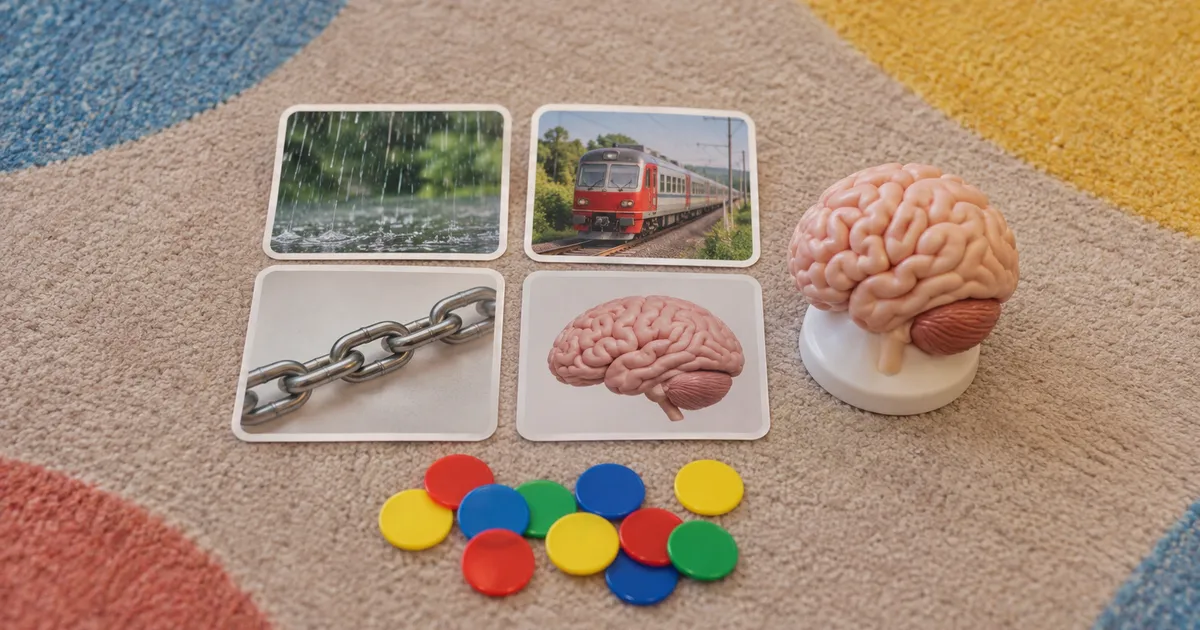
Place picture cards for rain, train, chain, and brain on the floor. Say a word. The child points, jumps, or puts a counter on its picture.
- School-age kids: Build words with letter cards. Keep ain together, then add r, tr, ch, or p.
- School-age kids: Sort words by nouns, verbs, and describing words. Some, such as stain, can fit more than one group.
- School-age kids: Compare related forms such as explain and explanation, or remain and remaining.
Choose one listening task and one reading or writing task. Stop when the child identifies the pattern, reads four words, and explains two meanings.
Check that the pattern is secure
- Ask your child to read four familiar -ain words.
- Say one new -ain word for your child to spell.
- Check that your child can explain two word meanings.
- Invite your child to use one word in a full sentence.
Short Practice Ideas for Home
Use a five-minute routine: hear, build, read, use. Say chain; let your child build and read it, then create a sentence. Next, the child chooses a word and the adult follows the steps.
Finish the -Ain Sentence
Choose from rain, train, brain, plain, and stain. Complete: “We waited for the ___.” “I wore a ___ shirt.” “The juice left a ___.” Then write two clues for another person to solve.
Multilingual children can give the meaning in another language, then return to the English word. This checks comprehension without making translation the task. LearnLink tutors can adjust reading, speech, and writing to the learner.
Comparing Similar Spelling Patterns
The sound ending rain has other spellings. Comparing them prevents children from choosing letters by sound alone.
Make two headings, rhymes with rain and does not rhyme with rain. Read each word before sorting. For spelling practice, sort -ain and -ane after completing the sound sort.
Common Mistakes and Simple Corrections
Children may read every ain group alike. Compare train and mountain. Say both naturally, ask whether they rhyme, and mark only the true -ain family word.
Children may insert a pause into the opening blend, turning train into “t-rain.” Model the blend slowly, join it to the ending as trrr-ain, then restore normal speaking speed.
Do not correct spelling, meaning, and grammar together. Set one goal. For -ain practice, confirm the pattern first and address other errors later.
- Ask your child to read five -ain words aloud, then correct one sound.
- Write rain, train, and plain, then circle the shared -ain spelling.
- Compare pain and pin, emphasizing the different vowel sounds before rereading both words.
- Build a four-line rhyme using chain, rain, train, and gain together.
- Revisit one corrected word in a familiar book and praise careful decoding.
When a word has several meanings or pronunciations, Cambridge Dictionary is a useful check before turning it into child-friendly examples.
Frequently Asked Questions
What Sound Does -Ain Usually Make?
In these words, -ain sounds like the end of rain, train, and plain. Treat it as one ending, not three separate letter sounds. Inside a longer word, ain may sound different. Read new words aloud before adding them to the family.
How Many -Ain Words Should a Child Learn at Once?
Begin with four to six familiar words. Add more after your child reads them and explains their meanings. The -ain Word Family for Kids: Words and Activities offers a wider set for different ages. A short group used in context beats a long copied list.
Why Does My Child Confuse -Ain and -Ane?
Both endings can make the same final sound, as in rain and cane. Hearing cannot determine the spelling. Show words side by side, circle the endings, and sort known examples. Introduce unusual spellings after both patterns are clear.
Can a Multilingual Child Practise This Word Family?
Yes. Keep the target sound and spelling in English, but let your child explain the meaning through another language, a drawing, or a gesture. This separates word knowledge from speaking speed. Finish with an English phrase or sentence using the -ain word.
Practise for five minutes on three days this week:
- Read four familiar -ain words aloud.
- Build one new word from letter cards.
- Explain two meanings using pictures or gestures.
- Write one complete sentence with an -ain word.
A short one-to-one lesson can show what level and pace fit your child — book a trial English lesson.
Stay updated on our latest tips and resources by following us on Instagram LearnLink.